
Pain relief
Massage for Headaches and Muscle Tension
Tension-type headaches often have a muscular pattern behind them. Here's how massage may help and what to talk through with Sarah.
20 March 20267 min readBy Sarah Grapentin, Diploma-qualified Remedial Massage Therapist (ATMS #53374)
What is a tension-type headache?
Tension-type headaches are the most common form of headache adults report. They typically feel like a tight band across the forehead, a heavy pressure at the base of the skull, or a dull ache across both temples. They come on gradually — often through the day rather than suddenly — and can last anywhere from a couple of hours to several days. Unlike migraines, they don't usually involve visual aura, nausea, or extreme sensitivity to light and sound (though a mild version of any of those can appear).
They're strongly linked to sustained muscular tension in the neck, shoulders and jaw — the classic sit-at-a-screen, hold-your-phone, drive-a-lot pattern. Many people experience them at predictable times: by Wednesday of a busy week, at the end of a long drive, the morning after poor sleep, or during a stressful season at work. See the tension headaches condition page for a fuller clinical picture.
Where do these headaches actually come from?
Tension-type headaches almost always trace back to a small set of muscles working too hard for too long. The main culprits are the upper trapezius (the muscles that run from the base of the skull down to the shoulders), the suboccipitals (the small muscles at the very base of the skull), the levator scapulae (running from the neck to the shoulder blade), the sternocleidomastoids (either side of the front of the neck), and sometimes the temporalis and masseter (jaw muscles) — see TMJ and jaw pain for how the jaw specifically feeds into the pattern.
When these muscles stay switched on too long — because of posture, stress, jaw clenching, or long hours in one position — they develop trigger points: small, hyper-irritated spots that refer pain outward in predictable patterns. Suboccipital trigger points refer pain up over the crown and behind the eyes. Upper-trap trigger points refer pain into the temples and along the side of the head. The pattern is remarkably consistent from person to person, which is part of why massage can be so useful — the map is well-known.
How can massage help?
Two things happen when Sarah works these muscles. First, direct pressure into the trigger points helps them release — the muscle stops referring pain, and the headache pattern eases. Second, and often more importantly, releasing the sustained tension in the neck and shoulders reduces the underlying load that's been driving the trigger points in the first place. The trigger point massage service is built around exactly this pattern.
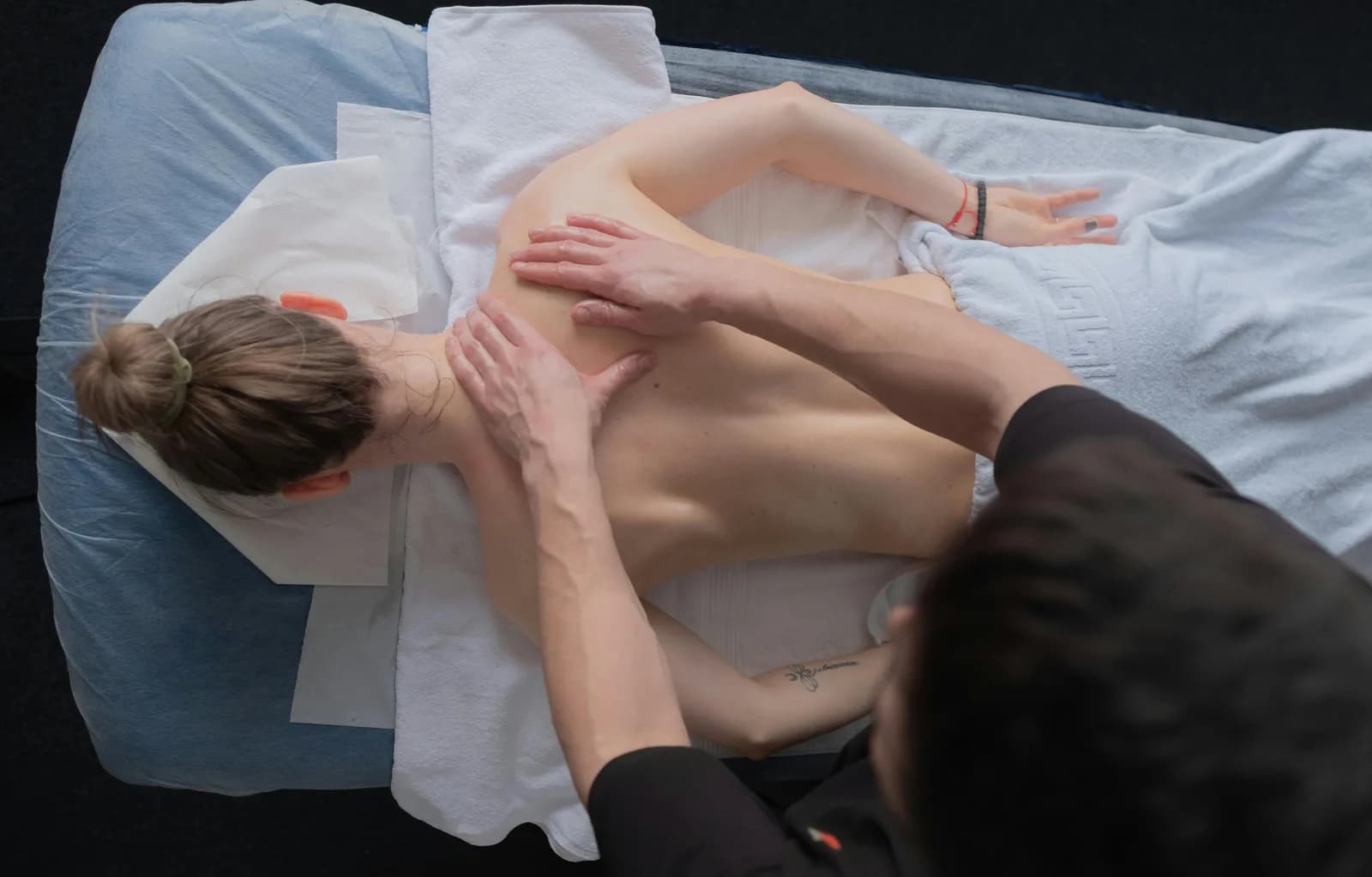
A typical headache-focused session opens with a short conversation about when the headaches come on and where you feel them. From there, Sarah works through the upper back, shoulders, base of the neck, and often the jaw and scalp, using sustained pressure and gentle stretch. Firm doesn't always mean helpful here — the suboccipitals and jaw muscles respond better to patient, moderate pressure than to aggressive work. If the neck and shoulders feel cold or locked, a hot stone element can help; warmth softens tissue and reaches muscles that hands alone don't fully settle.
Headache types and how massage fits in
| Headache type | Typical feel | Massage useful? |
|---|---|---|
| Tension-type | Band across forehead, heavy base of skull, gradual | Yes, often meaningful |
| Cervicogenic (neck-driven) | Starts in neck, spreads to head, one-sided | Yes, often very useful |
| Migraine | Throbbing, aura, nausea, light sensitivity | May support between episodes; not a treatment |
| Cluster | Severe, one-sided, around one eye, in bouts | Not a treatment; see GP urgently |
| Sinus | Pressure around eyes/cheeks, with congestion | Not directly; treat the sinus issue |
| Medication-overuse | Daily or near-daily, worse when meds wear off | Not a treatment; needs GP-led plan |
| Post-concussion | Complex, variable, following a head injury | Only with medical clearance |
How often to book for headaches
For someone with regular tension-type headaches — say two or three a week — a short block of fortnightly sessions usually makes the biggest change. Three or four fortnightly appointments gives the tissue enough momentum to actually shift the pattern; less than that, and you'll often notice small gains that don't quite hold. Once the headache frequency has dropped, monthly maintenance keeps the pattern from creeping back.
For someone with occasional headaches — one every couple of weeks — starting with monthly sessions is often enough. If the pattern doesn't respond within three sessions, tightening to fortnightly for a short block is the next step. See how often should you book a massage for a wider look at cadence.
What you can do between sessions
The work in the treatment room lands more securely when it's supported by small daily habits. None of these are dramatic; consistency is the point:
- Take short movement breaks every 45-60 minutes if you sit or drive for long stretches
- Warm shower on the neck and shoulders in the evening if tension is building
- Water — mild dehydration is a headache trigger for many people
- Sleep — under seven hours reliably increases headache frequency
- Screen positioning — top of the monitor at eye level, phone held up rather than looked-down-at
- Jaw awareness — if you're clenching, especially at night, mention it to your dentist
- Basic neck stretches: gentle side-to-side, ear-to-shoulder, chin tucks. Two minutes twice a day
When should you see a GP first?
Massage is a supportive tool for tension-type headaches — it isn't a diagnostic service. Some headaches need medical attention first, and it's important to know which ones. See a GP promptly if any of the following apply:
- A sudden, severe headache unlike anything you've had before
- Headache with fever, stiff neck, rash, confusion or a change in consciousness
- Headache after a head injury or fall
- Progressive headaches that are steadily worsening week to week
- Headache with new visual changes, weakness, numbness or speech changes
- Headache with jaw claudication (jaw pain when chewing) if you're over 50
- Any headache in a child that's persistent or unusual
Once serious causes have been ruled out, massage can be a valuable part of a wider plan. Sarah will happily work alongside your GP or physio and refer back if anything feels outside the scope of soft-tissue care.
What about hot stone and heat?
Warm work is often the difference between a headache-focused session that eases the pattern and one that only partially settles it. The suboccipitals — those small, deep muscles at the base of the skull that refer pain up over the head — respond beautifully to sustained warmth. Hot stone therapy with a specific neck-and-shoulders focus is one of the most reliable settings for chronic tension-headache clients. If heat isn't your thing, a warm heat pack applied for ten minutes at the start of a hands-only session can achieve much of the same softening.
TMJ and jaw tension: often part of the picture
Jaw clenching — especially at night — is a common driver of tension-type headaches. The masseter (the muscle you can feel bulge when you clench your teeth) refers pain into the temples and behind the eye in a pattern that's easy to mistake for a straightforward tension headache. Working the jaw muscles directly (inside the mouth with gloves, or externally along the temple and cheek) often gives headache-prone clients relief that neck-only work can't reach. See TMJ and jaw pain for how these patterns tie together, and mention any teeth-grinding or clenching at your intake — it changes what Sarah works on.
Do headaches respond faster than back or neck pain?
Sometimes yes, particularly for straightforward tension-type patterns driven by upper-trap and suboccipital trigger points — a single well-targeted session often reduces headache intensity within the same day. But the pattern coming back is a different question. Reducing the underlying muscular load, so the headaches stop reappearing every few days, usually takes the three or four fortnightly sessions mentioned above. First-session relief without follow-up is common; permanent shift without follow-up is rare.
Booking and pricing
A 60-minute remedial or trigger point session is the most common booking for headache-focused work — enough time for the upper back, neck, jaw and scalp without rushing. 45 minutes works for a focused reset if you already know your pattern; 90 minutes suits multi-area work when headaches ride along with shoulder or lower-back tension. Pricing is straightforward: 30 min $50, 45 min $65, 60 min $85, 90 min $120. See the pricing page and private health rebates for what your fund may cover. Book online or ring 0439 594 999.
If you'd like to talk through what's going on with your body and book a session, get in touch with Sarah on 0439 594 999 or book online. Private health insurance rebates may be available depending on your provider and level of cover.
Treatments that may help.
Conditions this post touches on.
For a deeper look at specific patterns Sarah works with, see the condition-focused pages below.
Tension Headaches
Focused massage in Port Pirie for recurring tension headaches — designed to help relieve the neck, shoulder and jaw patterns that often sit behind them.
Learn more →
Neck Pain & Cervical Tension
Careful remedial massage in Port Pirie for neck stiffness, postural tension and the surrounding upper back and shoulders — including supportive work alongside post-surgical rehab.
Learn more →
TMJ Pain & Jaw Tension
Considered massage in Port Pirie for jaw tension, clenching and TMJ pain — designed to help relieve the muscular pattern around the jaw, temple and face.
Learn more →