
Pain relief
Frozen Shoulder Recovery: How Remedial Massage Can Help
Frozen shoulder can be long, frustrating and patience-testing. Here's an honest look at where massage fits across the three stages — freezing, frozen and thawing — and what it can and can't do.
2 June 20267 min readBy Sarah Grapentin, Diploma-qualified Remedial Massage Therapist (ATMS #53374)
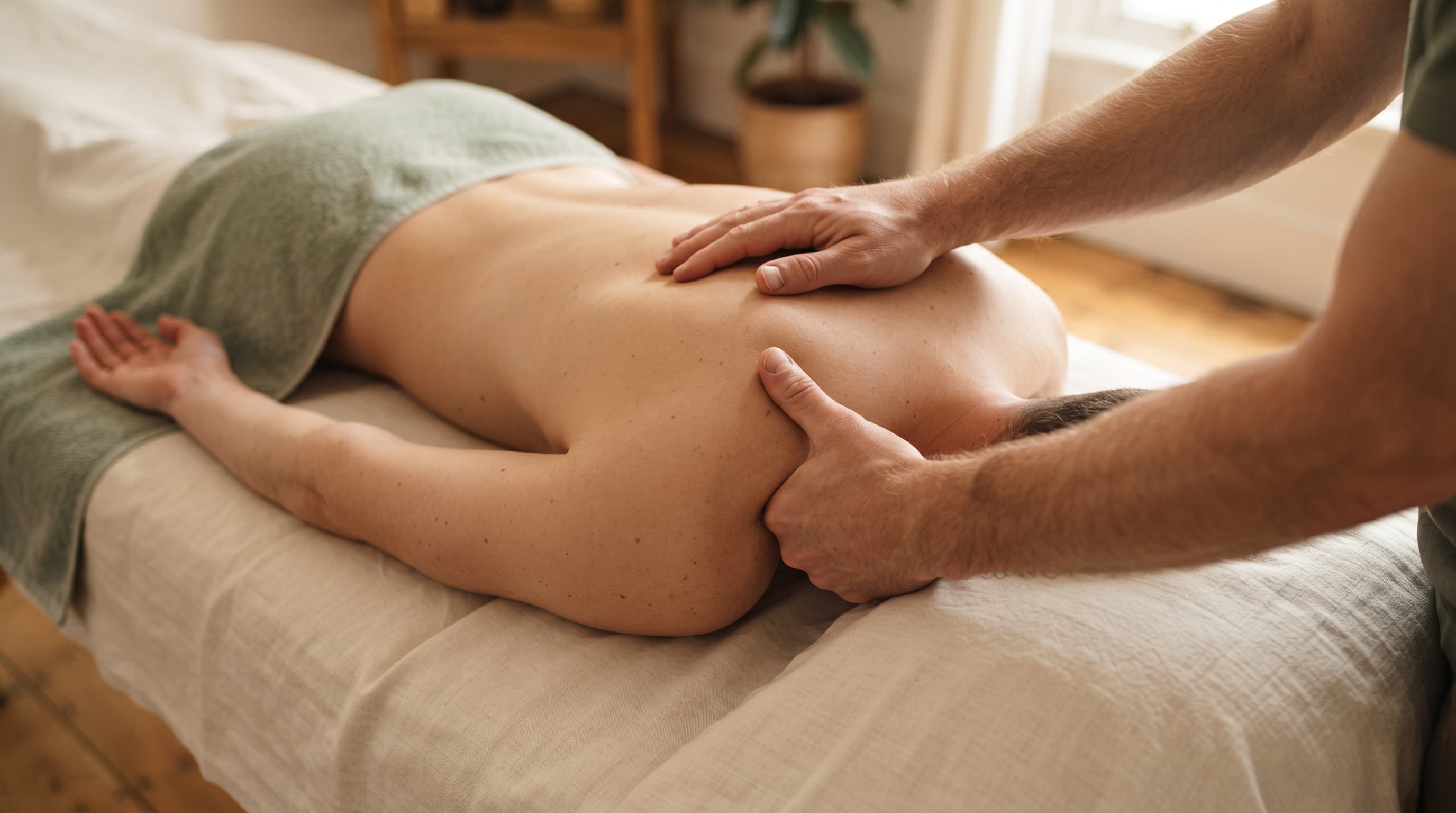
Frozen shoulder — clinically, adhesive capsulitis — is one of those conditions that can quietly upend a year or two of someone's life. It often starts as a vague ache, slowly worsens, and then settles into a long period where the shoulder simply will not move past a certain point. For clients across Port Pirie and the Mid North, it's one of the harder things to live with because it interferes with everything — reaching into a high cupboard, getting dressed, sleeping on the affected side, driving, working overhead on the tools, doing your job.
What is frozen shoulder, actually?
Frozen shoulder is a condition where the capsule around the shoulder joint becomes inflamed, thickens and tightens, restricting the joint's range of motion. Nobody fully understands why it happens. It's more common in women, more common between the ages of 40 and 60, more common in people with diabetes, and more common after a period of shoulder immobilisation (a sling after surgery, for example, or a rotator cuff injury that made you protect the arm). It's often idiopathic — meaning it just shows up, without a clear trigger.
The frustrating truth is that recovery is measured in months to years, not weeks. Most cases run one to three years from first symptom to full resolution. The good news: most cases do resolve, and the joint usually returns to close to full function.
What are the three stages of frozen shoulder?
| Stage | How it feels | Typical duration |
|---|---|---|
| Freezing | Pain dominates. Range of motion gradually drops. Sleep is often disrupted by pain on the affected side. | 6 weeks to 9 months |
| Frozen | Pain may ease. Stiffness peaks. Movement is genuinely limited — especially overhead and behind the back. | 4 to 12 months |
| Thawing | Range slowly returns over months. Pain continues to ease. Patience is the main therapy. | 6 months to 2+ years |
Where does massage fit in the recovery picture?
Massage isn't a cure for frozen shoulder. Recovery is largely a matter of time, and your GP or physio is usually the first port of call for diagnosis and a movement plan. What remedial massage can help with is everything the frozen shoulder forces the rest of your body to compensate for — tight neck and upper trap, sore opposite shoulder, an aching mid-back from holding the affected arm protectively all day, guarded pec and lat on the affected side, and a nervous system that's spent months in a low-grade pain-alert state.
Sessions usually focus on releasing the neck and shoulder tension that builds up around the affected side, plus the rib cage, chest and mid-back. Pressure on the affected shoulder itself is usually gentle — there's no useful 'breaking through' a frozen shoulder, despite what some clients have heard. Aggressive stretching or forcing range through a frozen shoulder tends to make it flare and slow the overall recovery.
Does massage help at each stage?
- Freezing stage — gentler sessions focused on the neck, opposite shoulder and upper back; the affected shoulder is often too irritable for direct work.
- Frozen stage — more useful ground for hands-on work; the surrounding compensations have had time to build up and respond well to release.
- Thawing stage — a great time for massage; the tissue is more receptive, range is returning, and clearing the guarding patterns helps consolidate the gains.
What does a session typically look like?
Sarah will ask which stage you think you're in and what your physio (if you're seeing one) has suggested. The session will often be side-lying or supported with cushions so you don't need to lie flat on the affected side, which is uncomfortable during freezing and frozen stages. Positioning matters more than usual because your comfort on the table shapes what the session can achieve.
From there, the work is usually a mix of soft-tissue release through the neck, upper trap and levator scapulae; trigger point work through the mid-back and opposite shoulder; gentle mobilisation around the scapula on the affected side; and slow, sustained holds on the pec, lat and chest tissue that tend to shorten during long periods of guarding. Pressure stays firmly in your comfort zone — frozen shoulder doesn't respond to pushing harder.
What massage cannot do for frozen shoulder
Being honest: massage can't shortcut the timeline. Frozen shoulder resolves when the capsule inflammation settles and the tissue starts moving again — that's a physiological process that runs at its own pace. What massage can genuinely offer is comfort in the meantime, reduced load on the compensating structures, better sleep, and a nervous system that isn't fully spent from months of guarding. That's meaningful, but it's not a cure.
How often should you book while healing?
Most clients working through frozen shoulder settle into a fortnightly rhythm during the freezing and frozen stages, then space out to monthly during thawing. It depends on how your body is responding — if a session helps you sleep for a full week, keep that rhythm; if the benefit fades in a few days, come in more often for a stretch. Sarah gives honest feedback each session about what's working and adjusts the plan accordingly.
What can you do between sessions?
- Stay consistent with any movement program your physio has given you, even on flat days.
- Heat the shoulder before bed — warmth often eases the dull ache that disrupts sleep.
- Side-sleep on the unaffected side with a pillow hugged in front to support the affected arm.
- Avoid the temptation to 'work through' the range restriction — that's a fast route to a flare.
- Track how you're sleeping and what movements feel worse; that pattern is useful information for Sarah and your physio.
- Be patient with yourself. Thawing is real but slow.
When should you see your GP first?
If you haven't had a diagnosis, see your GP first. Frozen shoulder can look like rotator cuff pathology, referred pain from the neck, cervical radiculopathy or (rarely) something more serious. A proper diagnosis — sometimes including imaging — matters. If your pain came on after a fall or specific injury, if it wakes you consistently, or if you notice weakness or numbness in the arm or hand, mention that to your GP too.
Related reading
If you're working through frozen shoulder, chiropractor vs remedial massage covers when to consider other practitioners, and remedial vs deep tissue massage covers why pressure isn't the only tool. See the frozen shoulder condition page for the clinical detail, or ring Sarah on 0439 594 999 to talk through where you are in recovery before booking.
What about cupping for frozen shoulder?
Cupping can be useful during the frozen and thawing stages, especially over the mid-back, opposite shoulder and around (rather than directly on) the affected shoulder capsule. The decompressive effect of cupping — lifting tissue upward rather than pressing into it — often reaches guarded, sluggish tissue that doesn't respond as well to pressure alone. It's not a magic fix, but many clients find it a useful addition to their remedial session while working through frozen shoulder. See cupping vs deep tissue massage for the comparison.
Does massage help with sleep disruption from frozen shoulder?
Sleep disruption is one of the hardest parts of frozen shoulder. Lying on the affected side hurts. Lying on the other side often pulls the affected arm across the body, which also hurts. Lying on your back leaves the shoulder unsupported and aching. Massage can help indirectly here — by reducing the surrounding muscular tension and calming the nervous system, sleep tends to be at least a little better on the nights after a session. Combined with warmth on the shoulder before bed and side-sleeping with a pillow hugged in front to support the affected arm, most clients find their sleep more manageable.
How to book and what to mention
When booking, mention that you're working through frozen shoulder and which stage you think you're in. That way Sarah can set up the room and cushions in advance for side-lying and adjust the plan for pressure and pace. You can book online or ring 0439 594 999. Weekday hours are 10am to 7pm. Private health rebates apply through most funds' extras cover — Sarah is ATMS registered (#53374). See the pricing page for session lengths and costs, or the frozen shoulder condition page for more on what a session looks like.
If you'd like to talk through what's going on with your body and book a session, get in touch with Sarah on 0439 594 999 or book online. Private health insurance rebates may be available depending on your provider and level of cover.
Treatments that may help.
Conditions this post touches on.
For a deeper look at specific patterns Sarah works with, see the condition-focused pages below.
Frozen Shoulder (Adhesive Capsulitis)
Careful, supportive massage in Port Pirie for adhesive capsulitis — designed to work alongside your medical and physio care through each stage of recovery.
Learn more →
Neck Pain & Cervical Tension
Careful remedial massage in Port Pirie for neck stiffness, postural tension and the surrounding upper back and shoulders — including supportive work alongside post-surgical rehab.
Learn more →