
Treatments
Cupping vs Deep Tissue Massage: Two Different Ways to Reach the Same Muscle
Deep tissue massage presses IN with firm sustained pressure. Cupping does the opposite — gentle suction that LIFTS the tissue and decompresses it. Same layers of muscle, opposite directions of force. Here's how to tell which one your body would benefit from more.
7 July 20266 min readBy Sarah Grapentin, Diploma-qualified Remedial Massage Therapist (ATMS #53374)
What is deep tissue massage?
Deep tissue massage uses firm, sustained pressure to reach the deeper layers of muscle and fascia. Strokes are slower than in a general remedial session, and the therapist may use fingertips, knuckles, forearms or even elbows to get the pressure needed. It's the modality clients ask for when they've had a heavy training week, a physical work stretch, or when a stubborn area of tension hasn't shifted with lighter work.
Common areas: the upper trapezius (that permanently-tight neck-shoulder zone), the erector spinae along the lower and mid back, the glutes and piriformis, and the calves. Common client type: tradies, farmers, athletes, and anyone whose desk posture has quietly built into hard, ropy muscle tension. Deep tissue is a specific technique used within a broader remedial massage framework — Sarah blends the two depending on what she finds.
What is cupping therapy?
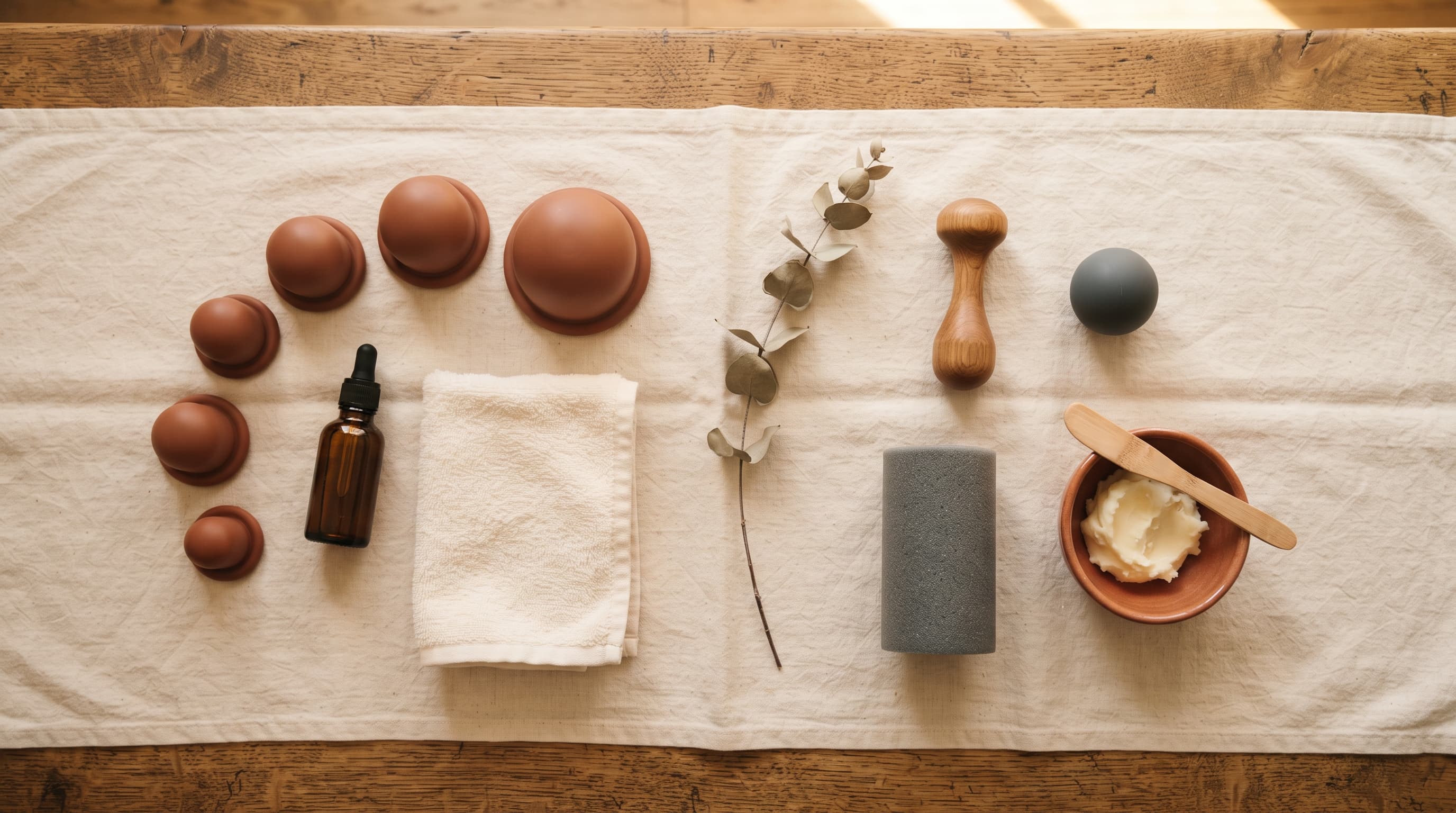
Cupping uses silicone or plastic cups placed on the skin, then draws a gentle suction to lift the tissue upward. There are two main techniques Sarah uses: static cupping, where the cups are left in place for three to five minutes on one area, and gliding cupping, where the cups are moved slowly across the skin with a thin film of oil. Both create a decompressive effect — the opposite direction of force to a traditional pressing massage.
Cupping has been used across many cultures for thousands of years and had a modern resurgence when Olympic athletes started sporting the trademark circular marks. It's especially useful for stubborn areas that haven't fully responded to pressure-based work, and for people who find deep pressure uncomfortable but still want a strong therapeutic effect. For a full deep-dive on what the marks mean, how long they last, and who cupping suits, see Cupping therapy explained.
Cupping vs deep tissue at a glance
| Aspect | Deep tissue massage | Cupping therapy |
|---|---|---|
| Direction of force | Pressing IN, downward and through | Lifting UP, decompressive |
| Sensation | Deep, sustained, 'good pain' pressure | Firm pulling / stretching on the skin |
| Techniques | Slow strokes, sustained holds, elbow and forearm work | Static cups (3–5 min) and gliding cups with oil |
| Session length at MBS | Full remedial session (30–90 min) | 10–15 min add-on, or 45 min stand-alone |
| Marks left afterwards? | Rarely — occasional bruising if worked deep | Round marks that fade over 3–10 days |
| Cost at Massages By Sarah | Standard session pricing | $15 add-on to any massage, or $50 stand-alone |
| Best for | Chronic, localised muscular tension and specific knots | Stubborn wider areas that haven't responded to pressure alone |
| Common client comment | "That's exactly where I need it" | "Weird at first — weirdly good" |
When to lean towards deep tissue
- You have specific knots or tight bands that need direct, targeted pressure
- You've had a heavy training week, a big physical work stretch, or a rough sleep pattern
- You like feeling worked on, and you're used to firm pressure
- The tension is concentrated in one or two localised areas (not spread out)
- You have muscular [back pain](/conditions/back-pain) or [neck pain](/conditions/neck-pain) that's clearly localised
- Lighter remedial work hasn't fully shifted the pattern over previous sessions
When to lean towards cupping
- The tension is spread across a wider area (whole back, both shoulders, entire hip region)
- Direct pressure hasn't fully broken through in past sessions
- You're curious to try something different from pure pressure-based work
- The area feels sluggish or heavy — slow to warm up, cold to touch
- You have shoulder patterns like [frozen shoulder](/conditions/frozen-shoulder) that pressure alone hasn't shifted
- You want to add depth to a session without needing more direct pressure
- You find deep pressure uncomfortable but still want a strong therapeutic effect
Can you combine cupping and deep tissue in one session?
Yes, and this is easily the most-booked combination at the clinic. Cupping is available as a $15 add-on to any full session — remedial, sports, or deep tissue — and Sarah blends it into the flow of the treatment rather than treating it as a separate module. See the pricing page for the full list.
The typical sequence is deep tissue first (to warm and release the muscle), then cupping over the last 10 to 15 minutes on the areas that still feel tight or sluggish. Reverse-order also works: cupping first to decompress a stubborn area, then targeted deep tissue into what the cupping opened up. Sarah decides the order based on what your body's actually showing her on the day.
What does deep tissue actually feel like?
It should feel like satisfying, deep pressure — the 'good pain' kind, not sharp. Many clients describe it as an ache that they can breathe with. If you're finding yourself tensing up, holding your breath, or gritting your teeth, the pressure has gone past useful and into unhelpful — that's the signal to speak up. Sarah adjusts constantly based on what your muscles are telling her, but nothing replaces a quick word from you at the moment. Deep tissue is not about punishment; it's about reaching the layer that needs the release.
What does cupping actually feel like?
Weird at first, then surprisingly good. The initial sensation is a firm pull on the skin — like a slow stretch on the outside of the muscle rather than a pressure sunk into it. Static cups feel like decompression, as if something in the area has been given room to breathe. Gliding cups feel like a firm massage stroke moving the wrong way — up and out rather than in and through. Most clients find the first few minutes surprising, then settle in and describe it as deeply relaxing.
Marks, soreness, and what to expect afterwards
**Cupping marks**: cupping typically leaves round circular marks on the treated area that fade over three to ten days. They look like bruises but rarely hurt — most clients can't feel them at all. The colour reflects how much stagnant blood and fluid was sitting in the area (light pink for well-circulated tissue; darker red or purple for very tight, stagnant areas). Full colour breakdown is in Cupping therapy explained. Not everyone marks — the strength of any marks varies session to session depending on hydration, sleep, and the state of the tissue on the day.
**Deep tissue soreness**: mild soreness for 24 to 48 hours after a deep tissue session is normal and expected — it feels like the muscle soreness you'd get from a good workout. Anything sharper, sudden, or lasting more than a couple of days is worth mentioning at your next visit. See why am I sore after a massage? for the full guide on what's normal and what isn't.
**Aftercare for both**: drink more water than usual on the day of the session, keep the movement gentle (a walk is better than full rest), and consider a warm shower or heat pack that evening. Avoid a hard training session the day after either treatment — save it for the day after that when your body will feel the benefit.
Pricing
Deep tissue is charged as a regular remedial session — see the pricing page for the full breakdown. Cupping is $15 as an add-on to any massage (usually the final 10 to 15 minutes of the booking) or $50 as a 45-minute stand-alone session. Private health rebates may apply to sessions that include remedial or deep tissue work, depending on your fund and level of extras cover.
When to avoid cupping
Cupping is safe for most healthy adults, but there are a few situations where it's not appropriate: active blood-thinning medication (warfarin, apixaban and similar), a bleeding disorder, skin conditions in the treatment area (severe eczema, psoriasis flare, open wounds, infection), or a recent surgical scar that hasn't fully healed. If you're pregnant, cupping over the abdomen or lower back is avoided. Mention any of these at booking so Sarah can adapt or recommend deep tissue only for the session.
Which should you book first?
If unsure — book a 60-minute remedial with the cupping add-on. That gives Sarah room to lead with whichever technique your body actually needs on the day, and to blend them across the session. It's the highest-value combination for a first visit or when you're not sure what's driving the tension. For related reading, Chiropractor vs remedial massage covers when to look outside massage entirely, and Remedial vs deep tissue massage covers a related but different comparison.
Ready to book or want to chat first? Book online or ring Sarah on 0439 594 999. She's happy to talk through what's going on and recommend a starting session, no pressure to commit before you're ready.
If you'd like to talk through what's going on with your body and book a session, get in touch with Sarah on 0439 594 999 or book online. Private health insurance rebates may be available depending on your provider and level of cover.
Treatments that may help.
Conditions this post touches on.
For a deeper look at specific patterns Sarah works with, see the condition-focused pages below.
Back Pain
Targeted, careful massage in Port Pirie for the lower, mid and upper back — designed to help relieve tension and support better movement.
Learn more →
Neck Pain & Cervical Tension
Careful remedial massage in Port Pirie for neck stiffness, postural tension and the surrounding upper back and shoulders — including supportive work alongside post-surgical rehab.
Learn more →
Frozen Shoulder (Adhesive Capsulitis)
Careful, supportive massage in Port Pirie for adhesive capsulitis — designed to work alongside your medical and physio care through each stage of recovery.
Learn more →